
A 24 person Maine company gets two quotes. The fully insured one is up double digits. The level funded one comes in lower, with a note about money back at the end of the year. The owner wants to know what the catch is.
There isn’t a catch, exactly. There’s a trade, and it’s worth understanding before you sign.
What level funding actually is
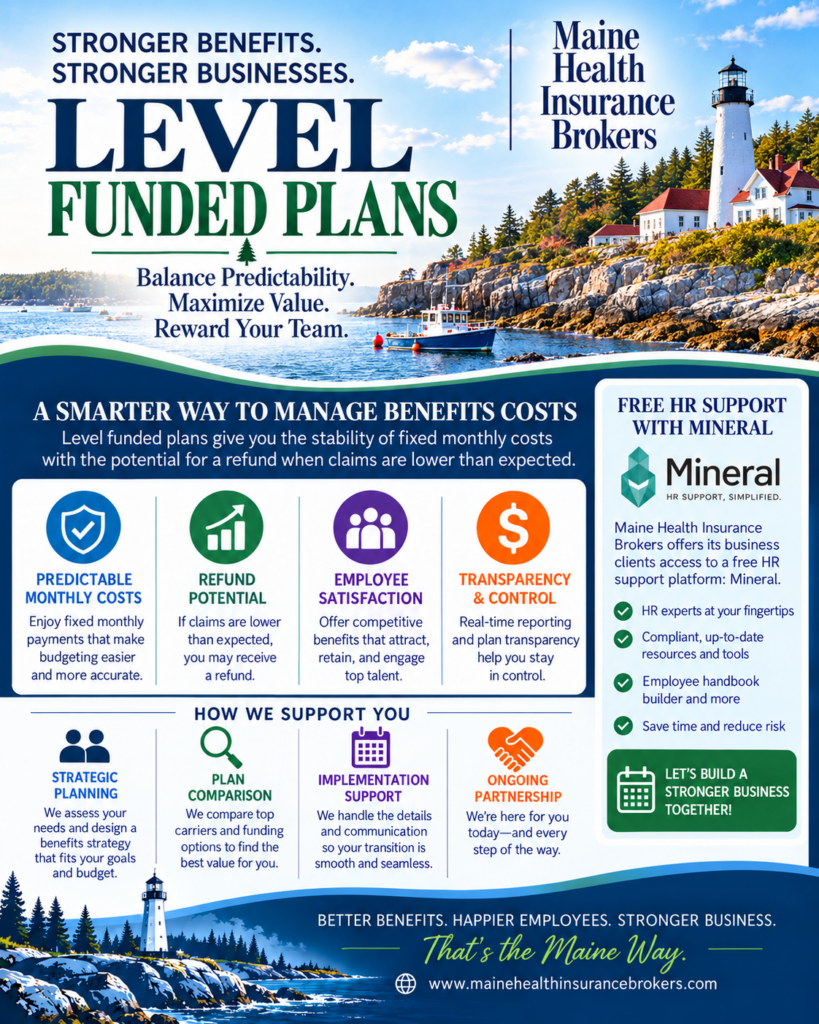
A level funded plan is a self funded plan wearing a predictable monthly bill.
Self funded means your company, not an insurance carrier, pays your employees’ medical claims. That sounds alarming until you add the two pieces that make it manageable: a third party administrator processes claims and runs the plan for you, and stop loss insurance caps what your company can be asked to pay. Stop loss is insurance for the plan itself. It picks up claims above a set amount, both for any one person and for the group as a whole.
“Level” is the billing. Instead of writing unpredictable checks as claims arrive, you pay the same amount every month.
How the monthly payment is built
Your level funded payment is three things bundled into one number.
- Claims funding, the projected cost of your employees’ medical claims for the year, spread evenly across twelve months.
- Stop loss premium, which buys the cap described above.
- Administration, which covers the third party administrator, the network access and the reporting.
Surplus, and who is actually at risk
If your employees use less care than projected, the unspent claims funding is surplus, and your company can receive money back after the plan year closes. That is the real appeal, and it is something a fully insured plan will never do for you.
Read the carrier’s terms before you count on it. How surplus is calculated, how long the carrier waits for late claims to settle, and how much comes back to you all vary by carrier and by contract. We’ll walk you through the actual language on whatever we quote.
The other side is honest too. Within the stop loss limits, your company carries the claims risk. A single bad year is a real possibility, not a theoretical one, and the plan is built to make that survivable rather than painless.
Underwriting is different, and you will feel it
Fully insured small group coverage in Maine is guaranteed issue. No health questions, no health based rating, no way for a carrier to decline your group.
Level funded is not part of that system. Before it quotes, a carrier will want to understand the health of your group, usually through employee health questionnaires or a claims history file, sometimes both. Your group can be quoted higher because of what it finds. Your group can also be declined.
That is the clearest way to say what you give up. Level funded moves you out of the small group protections and into a market where your employees’ health is a rating factor again. Premiums aren’t filed with or approved by the Maine Bureau of Insurance either, so the filed rate argument that applies to small group doesn’t apply here.
Why Maine is a different comparison than most states
In most states, level funding is pitched as a way for a healthy group to escape a small group pool full of sicker groups. Maine changes the shape of that argument.
Since 2023 Maine’s small group plans share a risk pool with individual coverage, with reinsurance behind it. The alternative you are comparing against is not a small group pool on its own. For 2027 the Maine Bureau of Insurance approved a 14.8 percent average increase on the individual side and 13.5 percent for small group, and those two numbers are connected in a way they are not elsewhere.
Whether level funding wins on price for your group is a Maine specific calculation, and it changes year to year with what the regulator approves. Anyone quoting you a national rule of thumb is guessing.
It is not right for every group
Level funding tends to work for younger groups with low turnover, stable staffing (at least 10+ employees continuously enrolled year around), and an owner with enough cash flow and enough temperament to absorb a year that goes the wrong way.
It tends not to work for smaller groups where two or three claims can swing the whole year, for groups with known serious ongoing conditions, or for owners who need one number they never have to think about.
We’ll tell you when we think it’s the wrong fit, and that’s often the more useful thing we can do with your census. Request a quote, send us that census and your current plan, and we’ll quote fully insured and level funded side by side so you can see the trade in your own numbers.